SIGN
UP FOR THE TRUNK NUTS NEWSLETTER!
Our e-mail newsletter
comes out about once a month. You'll learn about trunks, a little
about Maine, hear ridiculous stories from the North Maine Woods, and get
early notice about the trunks that come into the shop. You
get the jump on the rest of all humanity just by signing up.
Signing up is
wicked easy -
Register for BrettunsVillage.Com email
updates
by
clicking here
You can read some of our old newsletters by clicking
here.
Come on in and find a trunk you like!
Shown below are a few different
types of trunks and boxes, just to give you an idea of what passes through
the shop.


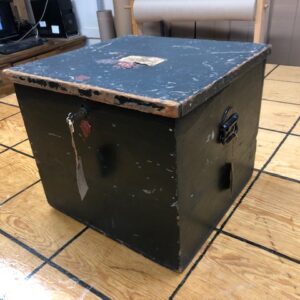
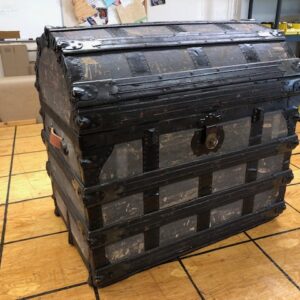
Just your standard wooden
trunks, ca. 1850 to 1880. Some similar styles were made like this
until as recently as 1940. Utilitarian, handsome, what more do you
want? Wicked cheap, too. Originally these were covered with
green or black canvas. Not very unusual, so don't expect to pay an
arm and a leg for this style. These turn out to be beautiful and
are quite useful for storage.

Here's what we recommend
to finish the inside. Remove the old wallpaper and sand/stain the
wood, like the trunks shown above. If you have bugs in your area,
plain wood is better than fabric or wallpaper (the little bugs will move
in between the trunk and the fabric/paper). We fix up and sell a
lot of trunks like this, redone inside and out, as shown here. USA
Shipping is included in all of our prices.
Check the FOR
SALE section for info. While you're in the shop be sure to
think of your loved ones and how much they'd love to get a trunk from our
shop. Or, think about our loved ones and how much they'd like a lobster
dinner paid for by you...
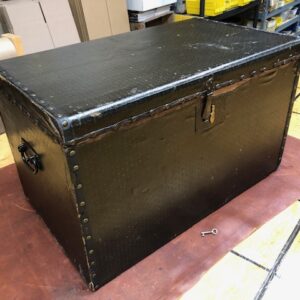
Maybe you'd prefer an old
pressed-tin covered trunk. Not much wood showing, so this type sells
a little more slowly than some, even though they're quite striking once
they've been redone. Some were painted, like the one above, others
were glazed. Often the glaze didn't last very long. Sort of
like the shop owner's hair.


Leather-covered trunks
were all the rage in the early 1800s. Well-known trunk makers from
that time include Robert Burr of Boston (maker of the saddle trunk shown
on the left), the Saratoga-style trunk makers (center photo), and the stretched-hide
and brass tack style (on the right) made by several companies all around
the US. You may find one of these with the leather in rough shape,
or the leather may be gone altogether. You can still have a great
trunk for display by finishing the wood beneath, and polishing up all of
those little brass tacks. If the leather is in fair to good condition
it can be oiled and saved, probably for another 200 years or so.
Then again, if your kids are like ours, you might get another four to six
months out of it, but it'll be a fun time.
Old Toolboxes


Toolboxes are lots
of fun. You'll never see two of these alike. Each was typically
hand-crafted by the owner, and it was sized to meet that person's unique
tool needs. Look for wide pine boards, special compartments to hold
certain tools, and maybe some dents from shins banging into it. Husbands
love these old toolboxes, but none of them can really explain why.
I've got a few of them that I've kept for myself, and I couldn't tell you
why I hang on to them, or what, if anything, I'll ever put into them.
I just like em.
You really should be in Maine, so if you're wise
enough to visit, you might want to check the Maine
Office of Tourism's site and also the State-o-Maine's
pages for touristing goodies.
Hope to see you upcountry!
Churchill Barton, Proprietor
Site
Map